


DIY Box Joint Jig for a Table Saw Crosscut Sled
A table saw crosscut sled is one of the most useful jigs you can build for your woodworking shop. It makes accurate crosscuts easier, supports workpieces during cutting, and can be adapted for a variety of joinery tasks.
One of my favorite ways to get even more use out of a crosscut sled is to add a box joint jig.
This compact attachment turns an existing table saw sled into a versatile joinery jig for cutting accurate, evenly spaced box joints. And because it uses an adjustable fence and interchangeable indexing keys, you can fine-tune the fit and cut different sizes of box joints without building a separate jig for each one.
Best of all, the attachment is small and easy to store when you're not using it.
Turn Your Crosscut Sled into a Box Joint Jig

After building my first crosscut sled, I quickly realized how versatile it could be. Rather than building a dedicated jig every time I needed to make a different cut, I started looking for ways to expand the sled's capabilities.
When a woodworking project called for box joints, I came up with this simple add-on.
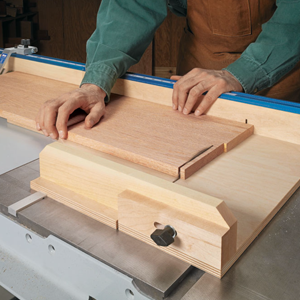
The jig attaches to the crosscut sled and provides an adjustable indexing fence that helps position the workpiece for a series of evenly spaced cuts.
Unlike a traditional full-size box joint jig, this attachment takes advantage of the support and guidance already provided by the sled.
That makes it a practical choice for woodworkers who want accurate joinery without adding another bulky jig to their shop.
How the Adjustable Box Joint Jig Works

The jig consists of a plywood fence and a cleat that slides along a track on the crosscut sled.
The sliding arrangement allows you to position the fence relative to the saw blade, while a built-in micro-adjustment mechanism makes it easy to fine-tune the setup.
This adjustability is important because box joints depend on consistent spacing between the fingers and slots.
Even a small error in the position of the indexing key can result in joints that are too tight or too loose.
With the micro-adjuster, you can make small corrections to the fence position without repeatedly rebuilding or repositioning the jig.
Fine-Tune Box Joint Spacing with a Micro-Adjuster
The micro-adjustment feature is one of the biggest advantages of this design.
Rather than relying entirely on trial and error to position the indexing fence, you can make controlled adjustments until the spacing produces the fit you're looking for.
Once the jig is properly adjusted, the indexing key helps maintain consistent spacing as you cut the remaining fingers.
This makes it easier to produce matching box joints for drawers, boxes, and other woodworking projects.
Interchangeable Fences for Different Box Joint Sizes

The fence is made from plywood with an indexing key glued into a slot.
The indexing key serves as a reference for positioning the workpiece between cuts.
Its width should match the desired size of the box joint fingers.
For example, a jig set up for 1/4" box joints requires an indexing key sized to match that joint.
Rather than trying to make one fence accommodate every size of box joint, I made several interchangeable fences with different indexing keys.
When I need to cut a different size of joint, I simply swap the fence.
This makes the jig more versatile without complicating the design.
Woodsmith Tip: The indexing key and cutting width need to work together to produce properly fitting box joints. Make test cuts in scrap material and adjust the fence until the fingers and slots fit together without excessive force or noticeable gaps.
How to Cut Box Joints with a Crosscut Sled

Using the attachment is similar to working with a conventional table saw box joint jig.
Start by installing the jig on the track of your crosscut sled.
Position the fence for the size of box joint you're cutting, then use the micro-adjustment mechanism to fine-tune its location.
The indexing key establishes the spacing for the fingers as you work through the cuts.
Choose the Right Table Saw Blade
The blade you use depends on the size of the box joints you want to make.
For larger box joints, a dado blade can remove the required material in a single pass.
For smaller joints, a standard rip blade may be all you need.
Using a regular saw blade can eliminate the need to install a dado set, particularly when you're cutting narrow box joint fingers.
If the desired slot is wider than the saw kerf, you'll need to make additional passes to remove the remaining material.
Make a Test Cut Before Cutting Your Project Parts
Before cutting the actual workpieces, make a test joint using scrap material of the same thickness.
Check that the fingers fit into the matching slots without excessive force.
If the joint is too tight or too loose, use the micro-adjustment mechanism to fine-tune the fence position.
Once the setup produces a good fit, you can use the indexing key to make the remaining cuts consistently.
Always keep your hands clear of the blade, secure the workpiece against the jig's fence, and use the crosscut sled with the appropriate blade guarding and workholding setup.
Why Add a Box Joint Jig to Your Crosscut Sled?
There are plenty of ways to cut box joints at the table saw, but this attachment offers several practical advantages.
Compact design. Because the jig uses your existing crosscut sled, there's no need to build or store a large, dedicated box joint jig.
Accurate adjustments. The micro-adjustment mechanism makes it easier to dial in the spacing needed for a good-fitting joint.
Multiple joint sizes. Interchangeable indexing fences allow you to cut different sizes of box joints with the same basic attachment.
Versatile blade options. Depending on the size of the joint, you can use either a standard saw blade or a dado blade.
Easy setup. Once you've established the proper fence position, the indexing key helps make repeatable cuts.
It's a simple way to expand the capabilities of one of the most useful jigs in your shop.
Get More from Your Table Saw Crosscut Sled
A well-built crosscut sled can do much more than make accurate crosscuts.
With the addition of this compact box joint jig, you can use the same sled to create strong, attractive joinery for boxes, drawers, and small cabinets.
The interchangeable fences and micro-adjustment feature make it easy to accommodate different joint sizes while reducing the trial and error often associated with cutting box joints.
If you already have a crosscut sled on your table saw, this handy attachment is a great way to put it to work on even more woodworking projects.
Explore More Woodworking Jigs & Fixtures
Get more accuracy, versatility, and efficiency from your woodworking tools with shop-made jigs and fixtures. From table saw sleds and box joint jigs to router guides and specialized workholding accessories, our collection of woodworking jigs and fixtures features practical solutions for common shop tasks.
READ MORE → Explore More Woodworking Jigs & Fixtures


